

Froggy Ads

CASE STUDY 01

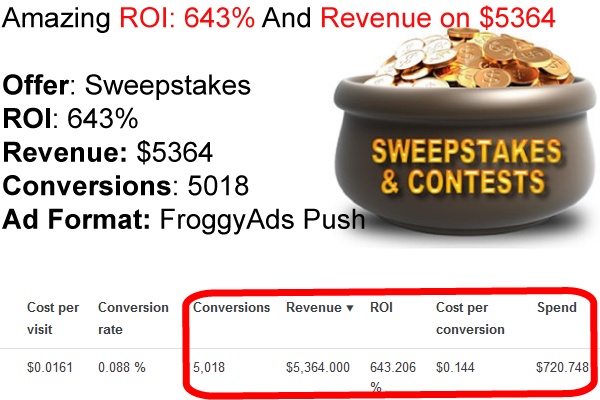
A quick benchmark of push notification performance from a real advertiser. Key stats: 5018 conversions, $720 spend, 643% ROI, $0.0161 CPC, Tier 2 GEO's, 2 days old campaign, 10 creatives. Use it as inspiration for your own testing plan.

  • Outcome: 5018 conversions recorded in the reporting.
  • Spend level: $720 total spend during the sample window.
  • Efficiency: reported ROI was 643%.
  • Targeting: traffic mix included Tier 2 GEO's GEO segmentation.

Here is a case study from one of our advertisers, who used our push notification ad format.

5018 Conversions With Push Ads


INDICATORS

Conversions:
5018
Spend:
$720
Cost per
conversion:

$0.144
ROI:
643%


SOLUTION

push notification ads case study   Push notification advertising
push notification ads case study   Tier 2 GEO's
push notification ads case study   10 creatives made
push notification ads case study   CPC: $0.0161
push notification ads case study   2 days old campaign
push notification ads case study   Monitoring and additional tuning.

Push Ads in Froggy Ads work on the CPC (Cost-Per-Click) pricing model. You pay only when a user clicks through your ad. Start bidding at just $0.003, depending on the geo.


Native At Heart

Push ads are a new type of native ad format, offering a non-intrusive, user-friendly and highly-engaging way for advertisers to reconnect and expand their audiences. Performing exceptionally well for almost any type of advertising campaigns, these interactive ad messages are delivered directly to users' mobile or desktop device anytime, anywhere!


Why should you use Web Push Notifications?

Web Push Notifications are those clickable messages that appear on your desktop, mobile or tablet even when you are not online. These messages are delivered in real time and are now being widely used by marketers for an effective communication. Research shows that it delivers 10X more CTR when compared over emails.

There are many advantages of using Web Push Notifications. It increases the CTR, boosts customer engagement, easy to subscribe, maintains privacy, consumes less time and much more. Push Notifications has now become the most used medium for communication. Well, the prime reason is nothing but its advantages over emails. The opt-in rate for email is 5%-10% while for Web Push Notification it is 10%-20%. And considering the click-through rate, it is 4%-5% for emails while it is up to 40% for Web Push Notifications.

If you take the usage of Web Push Notification industry wise, you will see that Ecommerce industry uses 21%. Fashion industry uses it more (nearly 70%). The web push notification usage in media/blog is 18% out of which 44% is used for sending out Breaking News. 3% is used for sending latest images, videos etc.

When it comes to industry wise usage of Web Push Notifications, we can see that each industry uses it for various purposes to boost their sales and engagement.


Push Ads: How To Create Push Ads That Converts (Please read it)
Our Push Ads Content Policy

RUN PUSH ADS IN FROGGYADS

I DON’T HAVE AN ACCOUNT, SIGN ME UP!


Alternatives (for comparison)

For due diligence, compare FroggyAds with other well-known ad platforms and networks:

Tip: compare optimization controls, reporting depth, and vertical restrictions.

Push case study #01: Launch setup

This page focuses on how a clean push campaign is structured from targeting to tracking. Use it as a practical reference when you set up your own push tests.

  • Goal first: decide if you’re optimizing for CTR, CPA, or ROI before you touch bids.
  • One change at a time: isolate variables (creative, GEO, landing, bid) to avoid noisy data.
  • Measure outcomes: clicks are not enough—track conversion events and post-click behavior.
  • Turn data into control: block weak segments quickly, then scale only stable winners.

Related pages: Push Ads · Ad Formats · Contact

Case Study 01 FAQ

Short answers about the setup, results, and how to replicate this style of test.

To show a realistic push notification test structure and what the early performance looked like in practice (2 days old campaign).
The advertiser reported 5018 with a total spend of $720. Efficiency was summarized as 643%.
This example used Tier 2 GEO's targeting plus creative iteration. In push ads, GEO + device + feed/source controls usually make the biggest difference.
The report mentions 10 being produced for this campaign. Testing multiple angles helps you find a click+conversion combination that holds.
Start with controlled budgets, track conversions from day one, and scale only the sources/segments that keep CPA stable. Push can move quickly, so iterate daily.
CPC is a useful signal ($0.0161), but ROI/CPA is the real KPI. A slightly higher CPC can be fine if the conversion rate and payout support it.
Create an account, deposit, pick the Push ad format, set GEO/device targeting, upload multiple creatives, and connect tracking (postback/pixel) so you can optimize sources with data.
Push is commonly used for lead gen, utilities, apps, and time-sensitive offers. Always confirm compliance requirements for your vertical before scaling.

Copyright FROGGY ADS 2026. All Rights Reserved